

Drone-based smart parking with AI
Our prototype from the elective module “Applied Robotics.”
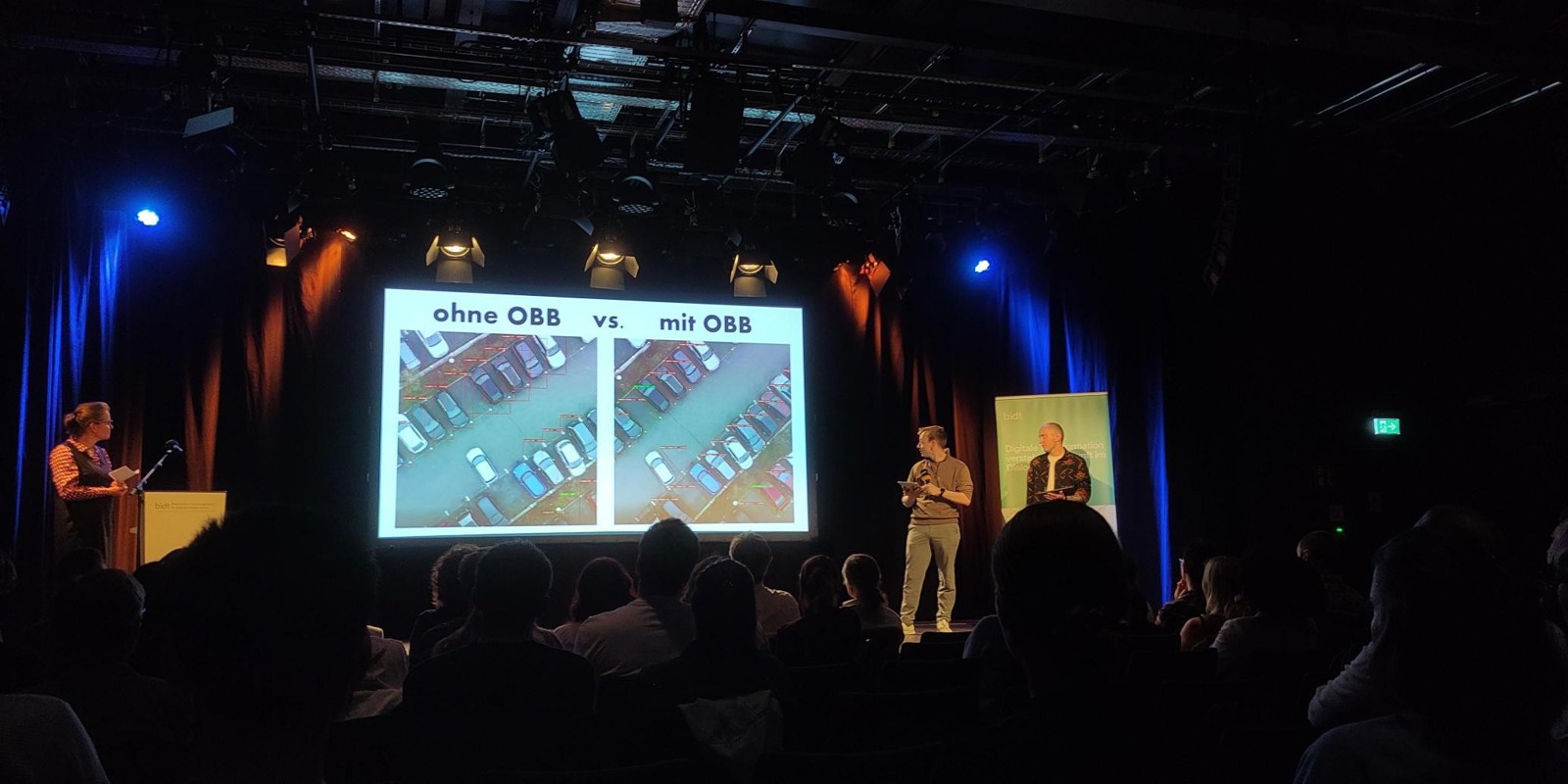
On May 21, 2026, Alexander Kaiser and I had the opportunity to present our project, “Drone-Based Smart Parking with AI,” at the BIDT Demo Day “Shaping the Future with AI and Digitalization” in Munich in the “Technology of the Future” category.
The prototype was developed in the elective module “Applied Robotics” as part of my SmvP degree program in Business Informatics (B.Sc.) at Hof University of Applied Sciencesunder the supervision of Jonas Kemnitzer.
Our Approach
Instead of permanently installed sensors or costly modifications, we use aerial drone imagery and a deep learning model based on YOLO11x-OBB to automatically detect available and occupied parking spaces—temporarily, non-invasively, and at low implementation costs.
How does it all work?
Infrastructure & Structure
Our prototype is based on a modular software architecture consisting of:
Video-streaming-capable device
Video-processing server
AI model for deep learning analysis
Web interface for graphical display of results
How It Works
The modular architecture goes through the following stages to generate the results:
Live video stream to server
The video sequence is split into individual frames and scaled/cropped to the required resolution.
The resulting frames are passed to the pre-trained AI model, which analyzes the image and returns the determined values in a structured format.
Extracted data is regularly requested and displayed via the web interface.
The key advantage of this architecture lies in both the interchangeability of the AI model and the hardware-adaptable computing power, which is adjusted by the number of images analyzed and their resolution.
This configurability allows these projects to run on consumer-grade hardware. Therefore, no high-end and expensive graphics cards are required.
Training the AI model
Instead of designing a model and its architecture from scratch, we use fine-tuning. This means we use pre-trained AI models and simply train their open weights to meet our specific needs.
When compiling our training data, we deliberately chose not to use the generic object class "car." Instead, we directly trained the model on the parking space states—specifically, "parking space free" and "parking space occupied." The reason: A model that only recognizes vehicles would have to retrospectively compare their positions with the parking spaces. For example, a car parked incorrectly or driving through would easily be incorrectly interpreted as "parking space occupied." By having the model learn the parking space state directly as a class, we avoid this problem, and the recognition becomes more robust.
Similarly, this avoids the need for pinning, i.e., explicitly marking parking spaces, which would severely limit the possible applications.
How the AI Model Works
The AI model used as the foundation is a CNN (Convolutional Neural Network). It scans the image layer by layer for patterns: The first layers recognize simple edges and contours, deeper layers combine these into shapes and finally into recognizable objects like cars. For each object found in the image, the model outputs a probability for each possible class (e.g., "car" or "free parking space"). These probabilities are filtered and transmitted to the server along with the image coordinates of the respective object.
Experiences & Learnings
For us as computer scientists, Demo Day in front of a large audience was an unusual but very exciting experience.
Even though we didn't win an award, it was impressive to see how diverse the other teams' projects were and how much emphasis was placed on pitching and storytelling alongside the technical implementation.
An important lesson for me: there's a big difference between "building a good system" and "presenting a good system convincingly"—both are crucial if ideas are to be seen.
Nevertheless, the subjective impression remains that technically sound projects from "engineering groups," despite their extensive prototypes, were judged more negatively by the jury and the audience. This contrasts with interdisciplinary groups, who mostly "only" presented an idea without demonstrating its implementation. The highly emotional and marketing-focused presentation seemed to be the deciding factor here.
Note of thanks
Many thanks to Alex for his collaboration, to Jonas Kemnitzer and Christian Groth for their support, and to Hof University of Applied Sciences and the Bavarian Research Institute for Digital Transformation for the opportunity to present our project in this context.
Our paper on the technical implementation and the analysis of our results is available in the Hof University of Applied Sciences library.